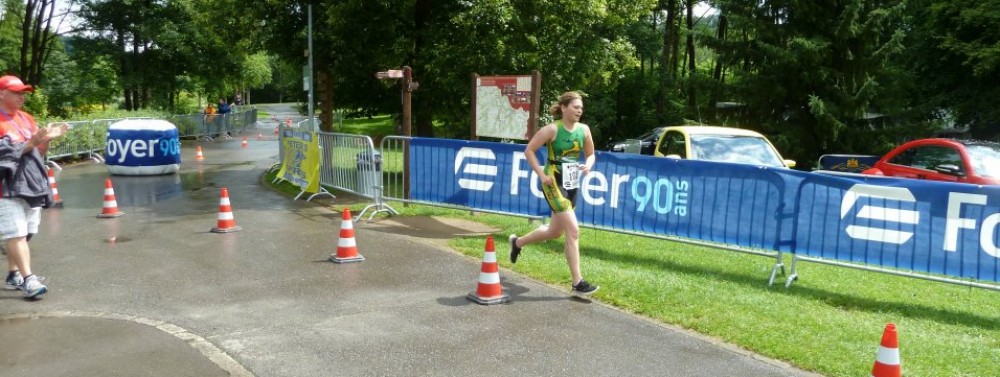
On Sunday 30th October 2016, I ran the Mainova Frankfurt Marathon, my third ever marathon.
Pre-race day & expo
I figured out this year that a short workout the day before a race works wonder for loosening off tight muscles and easing pre-race nerves. As I didn’t have the luggage space to carry a full spare set of running gear, I opted for a 1km swim in my hotel’s 25m pool instead. I included a longer 500m set as well as a few 25m sprints to get the heart rate up and some back- and breast stroke for a good all-round workout.
At midday, I met up with Paul and Fiona at the race expo. I do love a good expo – the pre-race exitment, the festival atmosphere, an opportunity to geek out over new kit and usually some great deal! The Frankfurt expo didn’t disappoint. What the Germans lack in queuing ability, they more than make up in efficiency. Where in Britain you’d go to a specific queue based on your race number or surname, in Frankfurt you simply rocked up at any counter and after confirming your details, had your number and baggage label printed and your chip primed right in front of you. The goody bag (doubling as the official kit bag, like at the London marathon) was on the better side of average and wonderfully random with a bottle of alcohol-free beer, water, toothbrushes (eh?), a large bag of dried apricots, some shower gel and the obligatory pile of spam.
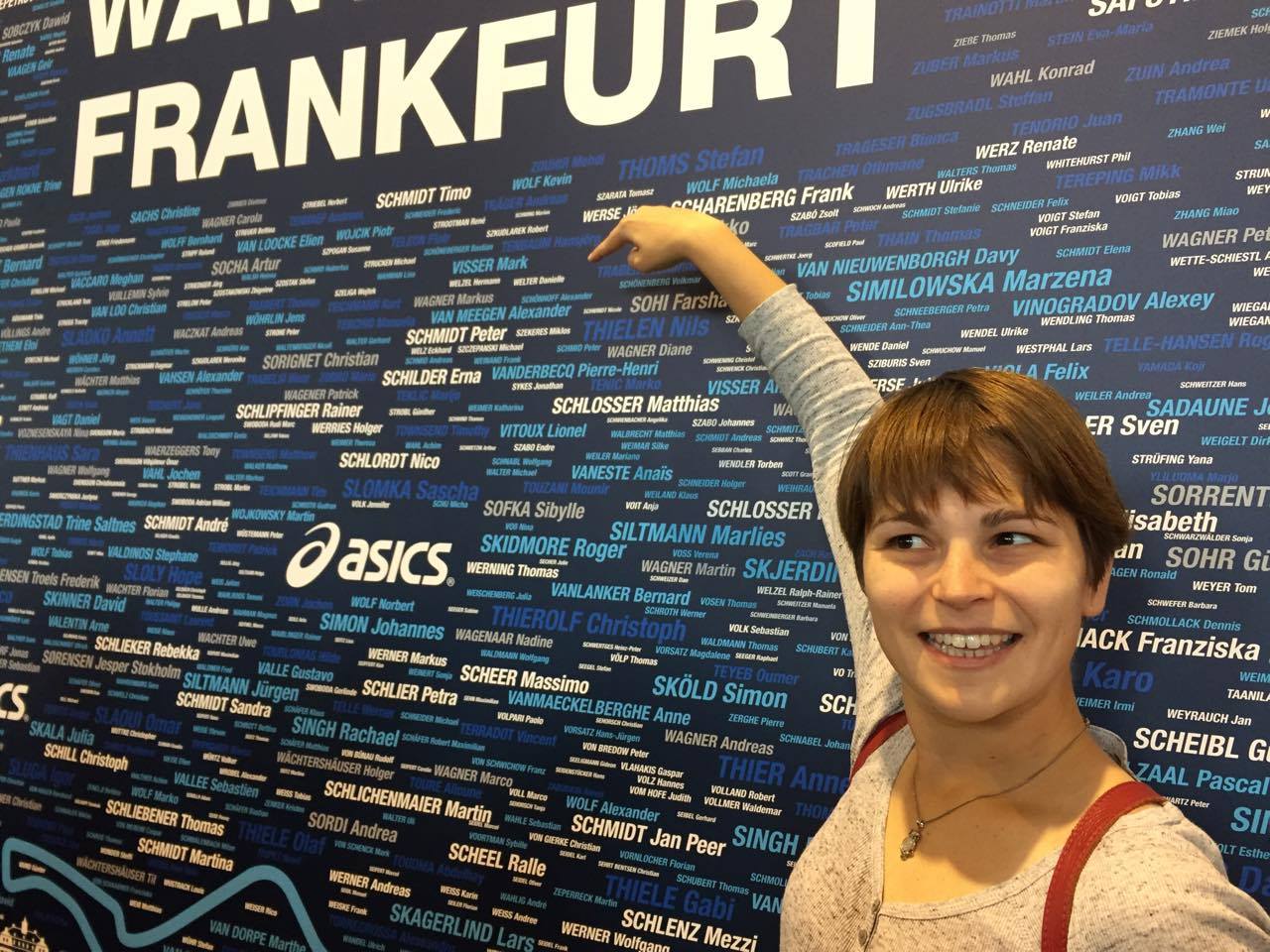
Not sure what I’m looking at!
There were a wide range of exhibitors at the expo, from sports brands to retailers to nutrition specialists. Paul and I both collected race pace bands from the Asics stall – I picked up two, a pre-ordered one for 4:18 and an optimistic one for 4:15. We posed for a picture with our race numbers on the finisher podium and successfully hunted for our names on the wall of competitor names printed onto a course map – not a mean feat, given that the names were of varying sizes and not printed in order, merely loosely grouped by surname. Finally, before heading home, I picked up a pair of Frankfurt Marathon-branded Asics running gloves and two pairs of bright yellow arm compression sleeves for a bargainous €15 (RRP €20 a pair).
Race day
I slept remarkably well for a race night and didn’t even wake up until a few minutes before my 6.50am alarm. Breakfast consisted of a banana, an oatmeal & raisin Cliff bar and a cup of tea plus about 300ml of water. At 8.15, I threw on my prepped kit and liberally slathered Vaseline onto any body parts likely to suffer from chafing. Reluctantly, my race day kit included Compeed plasters on my heels as I’d discovered the day before that my day shoes had rubbed the skin raw. I’ve had some bad experiences with Compeeds in races but decided that on balance, sore heels were more likely to ruin my race. I also decided to wear my new arm sleeves despite my insistence of never wearing new kit on race day. Both decisions would turn out to be excellent. By 8.30, I was on my way to the start, munching a Nakd Apple Crunch bar, which due the belated onset of race nerves went down a lot less readily than my main breakfast.
Despite the crowds outside the expo halls, I managed to find Paul and Fiona quickly. We posed for some photos in front of the start gantry before heading into the hall for bag drops and toilet queues. We parted ways about half an hour before the start as our starting pens were at opposite ends of the field. I made one final stop in the portaloo queue, which was remarkably short despite the relatively small number of portaloos (by UK race standards – perhaps German runners have stronger bladders than British ones).
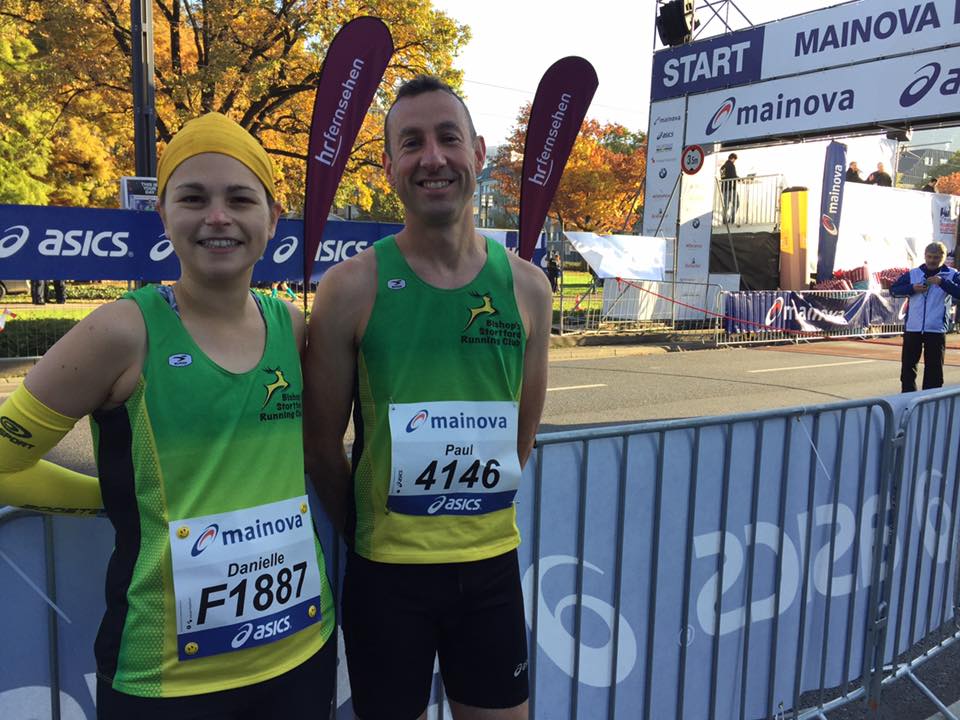
Go team Green&Gold!
At 9.55, I found myself a spot at the front of pen 6, surrounded by thousands of fellow 4h-plus and first time Frankfurt marathoners. Starting pens are the same the world over – full of excitement and nervous energy and this one was no different. The pens were separated by a band of tape and there was a gap between the rear of the crowd in pen 5 and our tape. As soon as the runners in pen 5 started moving, the front runners in pen 6 started to duck under the tape, barely giving the marshals time to get the tape out of the way. There was the usual surge and slow down as gaps were closed and then the crowd got stuck again. I felt momentary irrational irritation at being hemmed in but as we approached the start line, the crowd broke into a jog, the field thinned enough for everyone to find their space and by the time we passed under the start gantry, I was moving at a comfortable 6:30 min/km trot.
There first few kilometers of any race are always the hardest for me in the sense that I’m fresh and rearing to go, and holding a steady pace without going off too fast used to be the single toughest thing about racing. It’s a testament to how much I’ve learned this year that I found it easier than ever to regulate my pace. I was still going slightly faster than planned but after 5 extremely comfortable Ks around the 5:50min/km ball park, I decided that I could definitely maintain this pace for the foreseeable future and just went with the flow. The atmosphere in the city centre was fantastic, with cheering crowds and entertainment everywhere. I saw my family near our hotel, at around the 8 and 12km marks, and Fiona on the first km and again around 13km.
Sticking to my nutrition plan, I downed my first gel just ahead of the 10K water station. The water was a pleasant temperature, not as freezing cold as in Manchester and the first gel/water combo didn’t cause me any issues. Some of the water stations on the course were more accurately located than others, pretty much within 100m of where they were announced on the map while others, especially some of the minor stations, were as much as a kilometer out. There were enough stations for this not to be a problem in itself but it did cause me a bit of worry whether I was always going to have enough time between spotting an upcoming station and taking a gel before I got to the water tables.
After 14km, the route crossed to the south side of the Main river, winding through quiet leafy suburbs for about 10K. There was some support in the form of organised entertainment around which spectators clustered but overall, this was a rather boring stretch. Around 16-17km, I first became aware of some mild fatigue in my legs – nothing worrying or unusual, just my body letting me know that I’d been running for over an hour and a half at this stage. My pace was still steady and felt easy enough and my form was good, so I distracted myself with some mental pacing arithmetic and anticipation of my second gel, due at the 20km water station.
The second feed and the half-way point came and went, followed by the crossing back onto the north side of the river between 24 and 25km. Being back on the north side gave me a real boost – there was more crowd support and the remaining 17km didn’t feel daunting at all.
At 25km, I started to toy with the idea of changing my nutrition strategy. Bearing in mind the slightly higher than anticipated temperature on this gorgeously sunny day, I decided to grab a cup of iso drink as well as water in order to make sure I didn’t run too low on salts. Since I always like to wash out my mouth with water after taking on something sweet, this required some careful cup juggling and a short power walk as water was only available at the start of each feed station and I also didn’t fancy throwing sticky electrolyte drink over myself. My stomach took the change in plan pretty well and I carried on to the next water station, slightly behind schedule around 28.4km rather than the announced 27.5. At this point, I took my third gel (the only caffeinated one) as planned. While I didn’t exactly struggle with this gel, it didn’t sit as well as the previous two, which I took as a sign from my body that it’d had enough of gels. My nutrition plan included another gel at 35km but I decided to skip it in favour of iso-drink at 35km and, if needed, at 40km. While I stressed abou changing my nutrition strategy mid-race, it was definitely the right decision in hindsight. Obviously I can’t know how my body would have reacted if I’d stuck to the original plan but the combination of the anticipation of an extra hit of sweetness at 40km and the enforced walking breaks through the feed stations were a welcome boost when I started to flag.
Paul had warned me of the long, boring stretch of straight road from 30 to 35km, comparing it to the return from Canary Wharf to the Tower at the London marathon, a tiring, depressing stretch that seriously tests runners’ mental strength. While this bit definitely wasn’t the most interesting part of the route, crowds and entertainment started to appear from about 34km, making this part a lot less of a chore than expected. With less than 10km to go, I started to feel the fatigue but I was determined to maintain as closely as possible the roughly 5:55min/km pace I’d been running so far. I needed every mental boosting technique in my repertoire to keep going, especially when my right knee started to hurt out of the blue. Watching other runners fall apart in front of my eyes and remembering how awful I felt by this point in both Manchester and London, combined with the fact that I was still running ahead of my 4:15 pace band gave me the strength to keep pushing regardless of the pain.
Possibly the hardest part of the entire route was passing within 100m of the exhibition halls with just over 5km to go. Knowing the finish was so near and yet so far was tough. At just the right moment, my family appeared by the side of road and forcing myself to straighten up, wave and smile for the camera lifted both my spirits and my pace. Just a lap of town to go. Less than a parkrun.
All the laps around town were a bit confusing and I couldn’t quite get my bearings. Despite knowing the location of the final water station just before the 40km marker and knowing how far I had to go to get to it, I almost despaired during kilometer 39. Finally the station arrived and I had took one last much-needed (psychologically if not physiologically) drink before pushing past the 40km marker. I compared my actual time to the times on my pace bands – I was so far ahead of schedule that I could have dropped to 7min/km pace for the final stretch and still finish sub-4:15! With that in mind, I decided to make every second count.
My legs were pretty unhappy at this point, with the beginning of a cramp hinting in my left hamstring and my right calf tightening up unpleasantly on top of my already screaming knee. A finish sprint was certainly going to be interesting. I pushed on regardless, overtaking flagging runners left and right. On the final kilometer, things started to get rather crowded, with spectators partially pushing into the route and relay teams waiting for their final runner for a group finish. This became particularly annoying in the final few hundred meters, when several relay teams decided to run along holding hands in groups of four, with no consideration for solo runners in the narrowing funnel.
The entrance into the finish chute was a bit of an anticlimax. The indoor stretch was very short and I was too busy dodging other runners to really enjoy it. Although I did speed up a bit, I wouldn’t class my final steps as a sprint finish. I was exhausted and just wanted to stop. I crossed the line, hit “Stop” on my Garmin and stopped dead.
4:13:02. I’d done it! I had beaten my original target by almost 7 minutes and managed a pb of over 16! My legs hurt, I was tired, I was hot and I was desperate for some water but at the same time, I wanted to shout and dance! Only a fellow runner can really appreciate that finish line elation.
The finish area was the one and only part of the entire race experience that could have done with some improvement. The space was small and crowded and while marshals did their best to usher the finishers through to the medal collection and recovery areas, these were so blocked up as well that the entire crowd got completely stuck. It took me a good 5 to 10 minutes to collect my medal and at least another 5 minutes to find water and an iso-drink and make my way out of the competitor-only area to where I knew my family would be waiting. The food area was so busy that I decided against trying to pick up any freebies, knowing that food was waiting for me in my bag.
On the way out, I first came across Paul and Fiona, and was delighted to hear that like me, Paul’d had an amazing race, finishing almost 4 minutes ahead of his target and smashing his PB by a fantastic 9 minutes. I managed to find my family almost immediately and there were hugs and photos and stories and lots of excitement. After a short while, Paul and Fiona headed off to the airport while I went to get changed before going for another wander around the expo with my parents. To everyone’s surprise, I insisted on walking back to the hotel but I was worried about my legs seizing up while sitting on the underground. The walk home followed by a short visit to the hotel’s sauna and steam rooms and then a decent stretching session are probably the main reason why I only experienced minimal soreness in the hours and days after the race. As far as I’m concerned, heat definitely trumps cold!
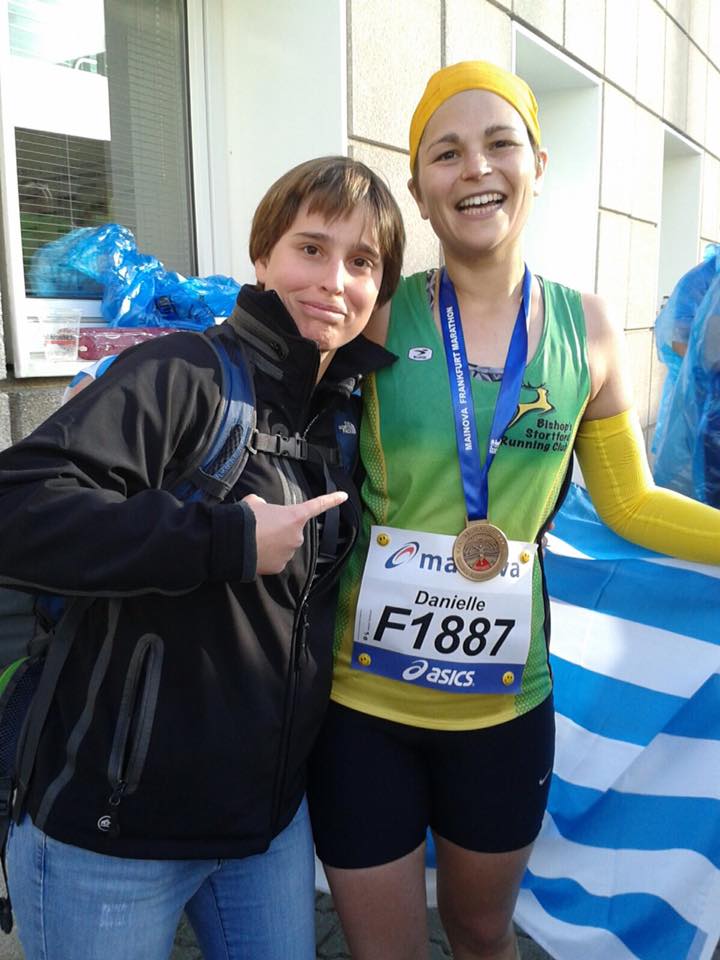
One proud runner with bling!
And so, after months of training and anticipation, Frankfurt marathon is over and done with. I can honestly say this was one of the best races of my life. The race itself is fantastically well organised, the course is excellent, weather conditions on the day couldn’t have been more perfect and I was in the best possible shape I could be. Maybe I could have run even faster, possibly even sub-4h, as some fellow runners were suggesting ahead of the race, but I don’t think I would have enjoyed the race anything like as much, nor would I have been able to run as consistently – 30s difference between the first and second halves, due mostly to the walking breaks in the water station rather than an overall slowdown. My official finish time is 4:13:00, a fantastic PB of 16:06 over Manchester. I enjoyed myself like never before and came away with minimal after effects on my body. I wish every race could be like this!
Strava output: https://www.strava.com/activities/761303947